I've been thinking about the world as it appears in fiction, and how it's different from the real world. For instance, in FictionWorld, there are hardly any bathrooms. Probably about 25% of the population works in law enforcement in some capacity -- mostly PI's, but lots of police detectives, too. Hardly anyone is named "Barb" or "Patty," and there are a surprising number of people named "Lily" (though the real world is catching up). Of course things are much more interesting in FictionWorld -- rarely does a day go by without some important or meaningful event. Planes crash a lot. People's hunches are almost always correct. Children are weirdly precocious and clever or sweet, though there are some pretty nasty ones too. Red haired women are vastly over-represented, as are "spunky" women. The elderly are spry and/or full of wisdom. Women always pick the "nice" guy, though only after enormous gnashing of teeth and rending of garments and a terrible betrayal by the "sexy" guy. They are never the same guy.
Unlike in the real world, there are relatively few petty annoyances in FictionWorld: fewer torn fingernails, parking tickets, unflattering haircuts, mysterious smells in the fridge, plantar's warts. No cold sores at all. And that's a good thing: why bother with fiction if life's irritations are going to follow you there?
I do think FictionWorld could use more doughnuts.
Monday, April 23, 2007


Sunday, April 22, 2007
The Assistant Apprentice's Wife
May I respectfully inquire as to what's up with all the factota? It seems to me that the publishing industry's affair with assistants, apprentices, and wives is still going strong, and those of us who notice these things are beginning to wonder if we're seeing a creeping genrefication of literary fiction, whereby the only kind of character (predominantly female) anybody wants to read about is one who is subservient to somebody else. Rhian and I are fond of making up joke literary blockbuster titles, and over the years have come up with The Pornographer's Accountant, The Cousin's Wife, The Roommate's Psychiatrist, and The Limnologist's Analyst.
There is hope, however, as books like The Catastrophist have of late been piling up on publisher-bribed new trade tables at chain stores all over America--our protagonists (aha!) are getting some agency at last, and all of us are hunkered at our laptops, isting the night away. Here are a few titles you can have, for your literary romance, if you like: The Marriagist. The Friendist. The Pregnantist. The Boyfriendizer.
And while I'm all up in it here, can we have a moratorium on book covers that depict a photograph of an idle woman? Lying on a sofa, except with the back to the camera, or the head turned away, or cut off. Or sprawled in the grass, or lounging in a tree. And the subset of individual-body-part covers, let's jettison them too: all the shod feet (pumped feet, I guess, to be more specific) pressed modestly together, and all the hands holding flowers. Please, just once, I would like to see a cover upon which a woman is kicking somebody's ass, or injecting some insulin, or opening a bottle of beer. Instead what we get is waiting. Waiting, and looking pretty. Readers, what are you thinking when you pick these books up? "Oh, look--demure people! This one's for me."
I don't know if I get to say this, being a guy and all. But I think the publishing industry is addicted to rewarding writers who present women in a passive context, and to celebrating feminine attractiveness and good taste over intellectual ambition. Otherwise it would be Lydia Davis, Joanna Scott, Kathryn Davis, Barbara Gowdy, and Kelly Link you tripped over trying to get to the public restrooms at Borders, wouldn't it?
Saturday, April 21, 2007
Kurt's in Heaven Now...
Though I've been thinking about Kurt Vonnegut since he died last week, I haven't had anything to say about him. Just: what a loss! There are other great writers left, but I can't think of any so cranky and well-loved.
I just finished Man Without a Country, a collection of short autobiographical and political essays, or scraps of essays. It's very much an old man's book: pessimistic and sentimental and packed with anecdotes.
Here's my favorite part (though there are lots of great bits):
And so he wrote a war novel that's packed with aliens and space travel. Instead of making his experience of war fit the expected narrative, he wrote it his own way, and it's about as true a book as you could hope to read.
Vonnegut was great because he never wasted a minute retelling all those comforting lies.
I just finished Man Without a Country, a collection of short autobiographical and political essays, or scraps of essays. It's very much an old man's book: pessimistic and sentimental and packed with anecdotes.
Here's my favorite part (though there are lots of great bits):
I was a writer in 1968. I was a hack. I'd write anything to make money, you know. And what the hell, I'd seen this thing, I'd been through it, and so I was going to write a hack book about Dresden. You know, the kind that would be made into a movie and where Dean Martin and Frank Sinatra and the others would play us. I tried to write, but I couldn't get it right. I kept writing crap.
So I went to a friend's house -- Bernie O'Hare, who'd been my pal. And we were trying to remember funny stuff about our time as prisoners of war in Dresden, tough talk and all that, stuff that would make a nifty war movie. And his wife, Mary O'Hare, blew her stack. She said, "You were nothing but babies then."
And that is true of soldiers. They are in fact babies. They are not movie stars. They are not Duke Wayne. And realizing that was the key, I was finally free to tell the truth. We were children and the subtitle of Slaughterhouse Five became The Children's Crusade.
Why had it taken me twenty-three years to write about what I had experienced in Dresden? We all came home with stories, and we all wanted to cash in, one way or another. And what Mary O'Hare was saying, in effect, was "Why don't you tell the truth for a change?"
And so he wrote a war novel that's packed with aliens and space travel. Instead of making his experience of war fit the expected narrative, he wrote it his own way, and it's about as true a book as you could hope to read.
Vonnegut was great because he never wasted a minute retelling all those comforting lies.
Friday, April 20, 2007
Audio Podcast: Heather McHugh
Earlier this afternoon I got to speak with Heather McHugh. Her books of poetry include Eyeshot, Hinge & Sign, Shades, and a slew of others; she has received two grants from the National Endowment for the Arts, the Griffin Poetry Prize, and a Guggenheim Foundation fellowship. In 1999 she was elected a Chancellor of The Academy of American Poets. She teaches in the MFA Program at Warren Wilson College, and is Milliman Writer-in-Residence at the University of Washington in Seattle. She's also one of my favorite living poets, and one of the few prominent writers to respond, back in the day, when Rhian and I solicited a bunch of bigwigs for our short-lived little mag, Teacup.
I can't recommend this podcast enough--McHugh is an awesome interviewee, full of energy and good humor, and the conversation took all kinds of unexpected turns. We discussed DJ music, the spondee, reading Finnegan's Wake aloud, and poetry as visual art. Check it out at the Writers At Cornell blog.
I can't recommend this podcast enough--McHugh is an awesome interviewee, full of energy and good humor, and the conversation took all kinds of unexpected turns. We discussed DJ music, the spondee, reading Finnegan's Wake aloud, and poetry as visual art. Check it out at the Writers At Cornell blog.
Wednesday, April 18, 2007
Iconic Characters
Man, wouldn't you love to write a book and have the protagonist become a household name? Like, you know, Holden Caulfield, or Hamlet, or Leopold Bloom. There was a time when I thought the name was what mattered--if you came up with a memorable name, people would think the character was iconic. Rabbit Angstrom. Damn! How can you beat that? I don't even like the Rabbit books (I don't mind Updike, but I'm more of a Henry Bech man), but I keep thinking I ought to try them again, and I believe it's because of the name.
I've tried, myself. My protagonists have been named Tim Mix, Grant Person, Happy Masters. An unpublished (so far) crime novel I wrote last year features a detective named Mal Friend. But it would appear that the book has to actually be kind of good. Like, you know, King Lear. With the book I'm working on now (about 50 pages to go, I think), I decided to just forget the memorable name thing. My protagonist is named Eric Loesch--a name that is rather dull, though I used it because it's (very) obscurely allegorical. In fact, his name really ought to have been Lethem, as I was trying to refer to the river Lethe, but of course it would be incredibly lame to appear to name him after another writer.
Huh, or maybe not. Maybe I should rename the guy Cormac Lahiri, or Truman Munro, or Flannery Alghieri Steel.
Or maybe I should try writing a decent book.
Tuesday, April 17, 2007
Nostalgia is Expensive
 For years I've been half-assedly looking for a copy of this book:
It's the first book I ever got out of the library (the Pocatello, Idaho, public library) with my own library card. And it has what struck me, at the time, as a truly creative and hilarious plot -- Mr. Egbert Nosh goes for a walk one day and his house (and possibly his garage) get lonely, so they follow him. Reading it might have caused my first experience of professional envy.
For years I couldn't find any evidence that it so much as existed, and I wondered if I'd remembered the title wrong. But when I checked abebooks.com recently, there it was, several copies in fact. But the cheapest was $150, for an ex-library (Pocatello, maybe?) one.
I don't get it. Does it have a secret cult following, or what?
Abebooks, for those of you who haven't tried it, is incredible. I don't think I've ever failed to find a book on it, and the little book stores that contribute to it ship quickly and without fuss.
Monday, April 16, 2007
Scribbler Flicks
 ...Wherein we continue the Week of Snark by dissing the new Will Ferrell vehicle, Stranger Than Fiction. We rented this because it's about a lady writing a novel, but were kind of taken aback by its lameness. Emma Thompson is a "great" novelist who has writer's block--she can't figure out how to kill off her main character, a tactic for which she is famous. Will Ferrell is her main character, an IRS auditor who slowly comes to realize he's in a novel. Dustin Hoffman is an English professor with horrible taste, and Maggie Gyllenhall is the implausible love interest.
Where to begin? The plot is dumb, of course--we never learn how it is that Will Ferrell managed to live a whole life without having been in the novel before, and why everyone else he knows has had real lives, and how it is that Emma Thompson herself is alive, and real, in the same world as that of the novel she's writing. And any interesting metafictional issues these contradictions might raise are, of course, conspicuously absent. But what really chafes is Emma Thompson--not her performance, which is about as good as can be under the circumstances, but what passes for the writer's life. She's "blocked," you see, there in her completely bookless apartment, which in this movie means she's got the whole novel finished except she just can't think of a good way to kill the main character. Has anyone ever in the history of writing ever suffered from such a problem? It's what dreadful writers think--that all they need is a good idea, and the rest will come naturally. Meanwhile, ideas are a dime a dozen, and it's writing itself that's hard. The book itself--the one Will Ferrell is a character in--is spoken aloud throughout the movie, and is about the worst thing imaginable--cutesy, awkward, cliche-ridden drivel that features a magic wristwatch. This doesn't stop Dustin Hoffman from thinking it's a work of genius, though.
Which leads me to the worst part. See, Emma Thompson's publisher is so concerned about her "block" that they hire an assistant, played by Queen Latifah, to help her finish. How quaint! A world in which a publisher actually gives a flying fuck whether a "literary" writer ever writes another word in her life. What next, a just war? A free and fair election? Gun control?
If you're dying to check out some writers on the screen, you're better off with A Fine Madness, in which Sean Connery plays a frustrated poet, and Jean Seberg the shrink who loves him. (And who is, incidentally, Rhian's favorite actress.) Connery's poet really does seem like a poet to me--his performance is hilarious and spot on. I'm partial to David Cronenburg's Naked Lunch, as well, particularly Judy Davis, and of course the hideous insectile typewriter and talking butt. And I even got a pretty good kick out of Secret Window, which, while not great, has Johnny Depp and John Turturro in it, and is based on a Stephen King story, which means at any rate that it has an OK plot. I liked The Squid And The Whale, too, although Laura Linney was criminally underused in it.
I'm sure there are others, but when you get down to it, there's a problem with writers as subjects for film drama that's hard to overcome. Writers are boring. Books are interesting.
Sunday, April 15, 2007
The Mistress's Daughter
Reviews keep calling A. M. Homes's new memoir, The Mistress's Daughter, riveting. And the first half of it is -- Homes describes how her loopy and desperate birth mother gets in touch with her after thirty years, and how Homes attempts to avoid her. If Homes seems a little, well, callous, who can judge her? She saves her fiercest wrath for her biological father, whom she names in the book and whose ass she describes. He may or may not deserve this treatment, but it was hard for me not to feel bad for him, which can't possibly be what the author intends.
So that bit, with all of its bitterness and fury, is indeed riveting -- like a drive-by shooting.
But then there's a long stretch of Homes imagining her mother's life, and an even longer trek through Homes's biological family history, and then a brief but sweetly sentimental evocation of her adopted grandmother and the pleasures of motherhood. These pages are haunted by an invisible person: Homes's adopted mother. Who is she? She's mentioned throughout the book, but barely described. I suppose Homes didn't want to write about her, but a reader can't help but think about her, a lot.
Memoirs have two layers: what the writer intends to say about her life, and what she doesn't say, but what comes across anyway. In this book it's difficult to separate the two, because Homes clearly wants to strip the genre of its pleasing nuggets of received wisdom and its easy conventions. But does she mean to sound so mean? Maybe she does, and maybe it's my own queasiness with brutal honesty that's the problem.
Or maybe there's no problem at all. After all, I read the whole thing.
Saturday, April 14, 2007
Mini Quiz
This post finds its inspiration in a task I always assign to my writing class--a whim I got from a book, a long story, its origin a Gallic quill. An author--call him G.P.--spins a yarn from which a particular thing is missing. Long months past that day, a guy ports it cross-Atlantic, and you can now buy it in a bookshop. This story isn't bad, but what's amazing about it is its form--by limiting his tools, G.P. shows us how to hack unusual paths to innovation in lit. Now and again, a pupil, in doing this task, will whip up a fablous paragraph or two, stunning this prof with truly groovy wordsmithing. OK, OK, it's all a bit stilty, I'll grant you that. But what can you ask for, what with this limitation at hand?
I think a Ward Six fan can probably crack this conundrum, right? For this post is actually a child of this particular task, if a kinda crappy stab at it, anyway. If you know who G.P. is (this task outlaws my saying who), what his book is known by, which country G.P. was from, and what is missing, post it!
I think a Ward Six fan can probably crack this conundrum, right? For this post is actually a child of this particular task, if a kinda crappy stab at it, anyway. If you know who G.P. is (this task outlaws my saying who), what his book is known by, which country G.P. was from, and what is missing, post it!
Thursday, April 12, 2007
Audio Podcast: Alice Friman
I got a chance to talk with poet Alice Friman today. She's author of eight collections of poetry, most recently The Book of the Rotten Daughter and Zoo, winner of the Ezra Pound Poetry Award from Truman State University and the Sheila Margaret Motton Prize from the New England Poetry Club. She's received countless awards and fellowships and lives and teaches in Milledgeville, Georgia. We discussed revision, ghosts, and Flannery O'Connor--check it out at the Writers At Cornell blog.
Wednesday, April 11, 2007
The Universe is Going to Give Me a Letterpress
Boy, do I want my own letterpress.
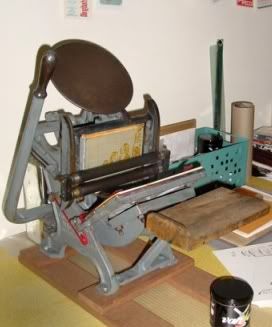
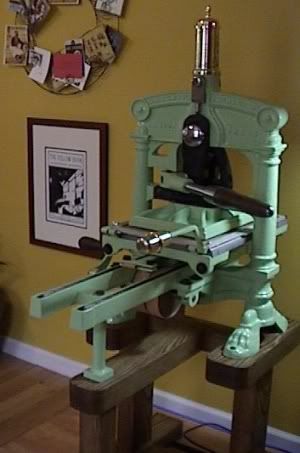
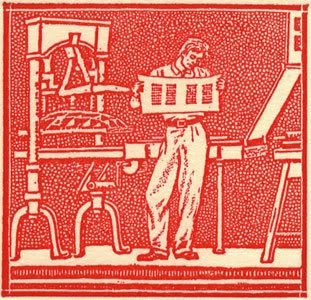
That's pretty much all I have to say tonight. People are doing incredible stuff with letterpress these days, and I'm jealous as hell. A few years ago I tried taking a class at the Wells Book Arts Center but my timing was bad -- I almost immediately got pregnant and couldn't stand the smell of the solvents or the long drive up the lake.
Holy moly: this site actually sells fonts! Shoot, who needs links; the internets is lousy with beautiful pictures of small press work.
It seems to me that hand-printing is the perfect marriage of craftiness and bookishness. At the bookstore recently I thumbed through a copy of The Secret and discovered that all I have to do if I want my own letterpress is think hard about getting one, and the universe will send one to me, stat.
That, I can do.
Tuesday, April 10, 2007
Desks
Over the past five years I've done most of my writing in an 8-by-10-foot garden shed that I outfitted with bookshelves, a wood stove, and a hardwood floor. It stands in our back yard, and has stood mostly unused since September, when I started this teaching job--I have a nice big office at work now that is pleasant to write in.
But since we're putting our house up for sale, I had to clean out the shed, and I made a gruesome discovery--a mouse had taken up residence in my desk. (I think it's the same mouse I mentioned in the typewriter post, the one that lived briefly in one of our typewriters.) I spent the afternoon cleaning everything and burning all my old papers that stank of rodent, and at one point I encountered the poor little bugger, clinging in horror to the edge of a mesh paper basket. Sorry, dude.
There is something awfully violating about having my desk infested. It's a big old (1930's, I'd say) wooden thing with drawers that stick and various parts falling off; it used to belong to a childhood neighbor, Mr. Baxter, who would sit at it in his cellar, thumbing through his vast collection of gruesome crime scene photos. Before I got it, I used to write at a buffet table, an idea I got from Chris Offutt, whose dank basement writing lair in Missoula inspired me to aestheticize glumly utilitarian surroundings into a kind of workaday literary fetish.
My desk at work is huge and hideous and aluminum, with a formica top printed in a woodlike pattern. It's awesome. You could fit entire children into the file drawers, though I mostly have them filled with excess paper napkins from the cafe underneath the arts library. I owned its love child when I was in college, an aluminum-and-formica affair barely big enough to get my legs under, and at it I wrote my first unfinished novel, a dumb fictionalization of some boring crap I did in high school.
My first actually-finished, worthless novel was called Telegraph Road, and it was about a rock band, and my teacher at the time said, "John, maybe you don't want this to be your first novel." It was written on the kitchen table. So were all the crappy short stories I wrote after college. I still write at the kitchen table from time to time. Different table, same vibe. And my juvenilia was written at a metal school desk my dad found at work, and later at my bedroom desk, the centerpiece of a hardwood desk-and-dresser sectional off of which my mother would clear any and all scraps of scribbled-on paper, however important, unless I carefully hid them.
Maybe it's my mother's fastidiousness that today makes me enjoy indulging in a hideously messy desk, with papers and books scattered everywhere, at least for short periods of time. The only thing I like better, in fact, is clearing it all off and starting something new. I can only hope that mouse, evicted once and for all, can similarly appreciate the pleasures of a fresh start.
Monday, April 9, 2007
Don DeLillo in the New Yorker
I just read DeLillo's new story in the NYer, though it's really an excerpt from the new novel that's coming in July. Since I've read about half of Falling Man (and it's not among the books we've put in Self-Storage) it was pretty familiar. In fact, it was so familiar, I couldn't really enjoy it. In fact, I kind of hated it.
I'm a fan of Don DeLillo because I like White Noise and Libra and because he has his own thing he works hard at -- a vision. Also, he's just plain talented, and a person has to respect that. But I couldn't read Underworld because of the excerpt he published in Harper's, a story he called "Pafko at the Wall." It was about baseball, which was bad enough, but it was also incredibly self-conscious. Forget it! JRL told me Underworld was great but I didn't have the stomach for it.
It's weird, though: when I was reading the New Yorker story I kept thinking, Hm, people are going to think this is pretty hot stuff. Yep, that bit there, pretty amazing! But at the same time, the material was so tired. It could be that I just read Ken Kalfus's book, which is about a very similar subject (man is in one of the Towers, survives, and it changes his personal relationships) or it could just be in the air. Or... it could be that DeLillo's style and his reputation overwhelms his subject. I found myself thinking that I couldn't even tell if the story was good or not, because I have all this backlog of feeling about DeLillo, and about 9-11, and about New Yorker stories.
I hated the excerpt because of the telegraphic dialog, which is meant to sound like real people talking but actually sounds like fake affected literary people, and because of the easy real-life drama. And -- and here I'm crawling very carefully out on a limb -- because it feels like DeLillo has appointed himself Voice of the Nation. I'm sure he didn't mean this, but reading that story I felt like I was being told how to interpret that day in 2001, and somehow that feels wrong.
I haven't talked to anyone else who's read it yet so I'm curious what people think about it.
Sunday, April 8, 2007
A Nasty Ending
I've posted about Ruth Rendell before--I've read almost all of her thrillers, police procedurals, and pseudonomous quasi-literary books (which she writes under the name Barbara Vine). Of all her books, the Vine ones are the most impressive, the procedurals the most exciting, and I loved the last Vine book, The Minotaur, a restrained gothic about a big scary house full of weirdos.
Her latest, which I got from Amazon.co.uk (it's not out here yet) is called The Water's Lovely. At first I was very excited about this novel, as it contains several details germane to our personal lives--a house, like the one we're buying, that has been divided into two apartments; a house, like the one we're leaving, that someone was murdered in; and a bathroom that contains the exact same Bonnard print that ours does. And the opening pages are quite exciting.
But the book disappoints. The mystery (did what's-her-name really kill that dude in the tub?) isn't very mysterious, the intersecting story lines are static and not terribly interesting, and the characters are awful.
Let me clarify this, because Rendell is sometimes superb at writing about unappealing people. Her best books, like The Minotaur, are populated by fully articulated characters, their peculiarities part of a pattern, their often unpredictable actions driven by powerful and complex motivations. But sometimes she seems to be phoning it in, and you get the baser part of her soul--she is prone to overdosing on the vain, the vulgar, the low-class, and the greedy, their shallow thoughts flatly stamped onto the page.
For the life of me, I don't know what she gets out of it. Somebody good enough to write Anna's Book or Road Rage (a terrific procedural--see the B-List sidebar) is willing to give us a lame menagerie like the one in The Water's Lovely? The worst part is that, in the end, (spoiler alert--here, I'll print it in white so you have to select the text to read it) all the people you hate the most end up getting happily married to one another, and the only two people you like get killed by a tsunami on the last page. I think this is the worst ending I've ever seen from her.
That said, she's disappointed me before, then come roaring back with something great. Perhaps these little thrillers have a purpose--the discharge of excess misanthropy, maybe, freeing the author to give her real characters the humanity they deserve. Meanwhile, I don't recommend this new book--though I have to admit, I did read to the end.
EDIT: Hey, P.S., this is our 100th post!
Saturday, April 7, 2007
Robert Lowell's Collected Poems
Why do we remember what we remember? Over Christmas I was talking to a psychologist friend of ours, who suggested that how we think about our lives depends on what we remember. But what if what we remember depends on what we think?
I took a class in college called Poetry Since 1945, and aside from my writing workshops, it might have been the most memorable class I ever took. It wasn't the class so much as the material, which was a revelation. I remember sitting at a wooden desk by a huge flung-open window that spring, being bowled over again and again by certain lines.
One was, "Like the sun she rises, in her flame-flamingo infants' wear."
For years I thought of that line. I couldn't remember who the poet was or any of the rest of the poem -- only that line. What was so great about it? Nothing in particular. I liked the sound of flame-flamingo and the image of it: pink flames. The line just gave me a feeling I liked, a sense of quiet urban shabbiness and a baby's oblivious optimism. I felt briefly injected into another life.
When the Internet got rolling I realized I could find this, or any poem at all, so I did: it's "Memories of West Street and Lepke," by Robert Lowell. This surprised me, because I had never thought of Lowell as one of my favorites. But Lowell's Collected Poems just came out in paperback, and even though I'm trying to move and it's a big book I bought it. And it's a delight. What Lowell was so good at was letting you know what his life was like -- what it was like to be him, to be in his head. Obviously there's much more than that. But it's what appeals to me, a confirmed non-poet.
Still, I wonder why that line, why not others? What's the logic behind the tangle of lines and stanzas that stick with us, and those that don't? Maybe, in this particular case, the image of a girl baby in pajamas awakened some almost totally stifled memory in me. "Flame-flamingo" -- after a long, gray-and-white winter bright colors are stimulating. Could that be enough?
Poetry can do a lot of things, but I like the way it works like a fishing net, trawling through forgotten parts of our brains, catching on things we maybe never noticed before.
Subscribe to:
Posts (Atom)
