Wednesday, February 14, 2007

Muckysnogger Booty Call

I'm susceptible to occasionally getting sucked into the world of word games and obscure limiting exercises, and at one point last year I was obsessively writing pangrams. These are sentences that use every letter in the alphabet. You know, "The quick brown fox jumps over the lazy dog." Which, according to the Wikipedia link above, was "developed by Western Union to test Telex/TWX data communication equipment for accuracy and reliability."

Of course, we know them as typewriter-testers, or, more commonly these days, font-testers. Rhian's favorite has long been "Pack my box with five dozen liquor jugs"--and at 32 letters, it's pretty impressive. The fewer letters you use, of course, the more powerful your mojo (a "perfect" pangram being one that uses each letter only once) but in my opinion the very best ones are the funniest, regardless of how many letters you use.

Wikipedia helpfully, and amusingly, supplies classic pangrams in many languages--the title of this post is a perfect one in Finnish.

My technique is to print myself a page of about 15 alphabets, all caps, stretching across an 8-by-11.5-inch page, with plenty of space between for composition. Then I cross off the letters as I use them. I wrote a dozen or so last year, which were published as "New Sentences for the Testing of Typewriters." Here they are:

Fetching killjoy Mavis Wax was probed on the quay.
“Yo, never mix Zoloft with Quik,” gabs Doc Jasper.
One zany quaff is vodka mixed with grape juice and blood.
Zitty Vicki smugly quipped in her journal, “Fay waxes her butt.”
Hot Wendy gave me quasi-Kreutzfeld-Jacob pox.
Jack's pervy moxie quashed Bob's new Liszt fugue.
I backed Zevy's qualms over Janet's wig of phlox.
Tipsy Bangkok panjandrums fix elections with quivering zeal.
Mexican juntas, viewed in fog, piqued Zachary, killed Rob.
Jaywalking Zulu chieftains vex probate judge Marcy Quinn.
Twenty-six Excedrin helped give Jocko quite a firm buzz.
Racy pics of bed hijinx with glam queen sunk Val.
Why Paxil? Jim's Bodega stocked no quince-flavor Pez.
Wavy-haired quints of El Paz mock Jorge by fax.
Two phony quacks of God bi-exorcize evil mojo.
What joker put seven dog lice in my Iraqi fez box?

Got any good ones? Put 'em in the comments!

Tuesday, February 13, 2007

I Heart Writers

The forecast at our place isn't looking especially romantic for tomorrow: school's been preemptively cancelled because of rumors of a big storm (last time they did that we got a whopping four inches; I'm so hoping for more) and dinner plans never got off the ground. Thanks to JRL's incredible grandmother, though, we are well stocked with chocolate.

But I would like to send a valentine to all the gorgeous male writers of the world. All the men I've ever loved have been writers of some kind (my first boyfriend was, and is, an amazing cartoonist) because, face it, nothing is more of a turn-on than a man putting pencil to paper. Or rolling a piece of paper into a typewriter. Or standing in front of a printer waiting as the pages of his oeuvre stack up. You are all incredibly sexy, and I love you.

That is all.

Monday, February 12, 2007

Our Typewriters


Oh boy, Rhian's gonna like this one. I was googling around for this new interview with Stephen Dixon that she'd been telling me about, when I stumbled onto a frankly awesome site called MyTypewriter.com. They have a section featuring various writers and their typewriters, and there was Dixon, and his Hermes Standard.

I know that typewriter well, because I've been corresponding with Dixon for like a dozen years, and he still uses it. Every letter I've ever gotten from him is typed, usually on the back of an abandoned manuscript page with a big ballpoint X over the text. For years I actually did this myself, sending people letters on the back of manuscript pages, because Steve is the world's coolest man, and I wanted to be cool in the same way.

Anyway, seeing this site got me thinking about our typewriters, and I went around the house taking pictures of them. They're above. (I think I'm missing one; Rhian will tell me.) The first is a big old Underwood--if it was a piano, you'd call it an upright. I actually wrote the second draft of my novel On The Night Plain with it, since it was a forties novel, and I wanted to write it using forties technology. (My Underwood is actually a sixties machine, though.) There's a label above the platen telling you the name of the shop in Missoula, Montana where you can have it serviced. I doubt it's still there. Sadly, when I picked the Underwood up from the shelf in my writing shed where I keep it, a bunch of birdseed hulls fell out--mice have been living in it.

The next one, a Corona portable, I only ever wrote a couple of stories on--the first draft of the short story that eventually turned into Mailman was one of them. It looks great, because it's in a very sturdy case. Little moldy blooms are all over the outside of the case, though--I need to clean it.

Next is a Remington we got at a yard sale. It's only ever been a display piece--it's sitting next to me now, on the dining room bureau. It's called NOISELESS 8, a name I've been wanting to steal for a rock band for years now.

Finally, there next to my knee, is our Selectric--I think the only thing I ever used it for was applying to grad school, but Rhian wrote on it a lot, and I think her ex-boyfriend did too. Or maybe that was a different one--at some point we had a few of them, sold the crappiest ones, and used the money to have the nicest one fixed up. At any rate, Selectrics were, and are, fabulous typewriters--that hum was like the sound of thinking.

The thing is, I started writing seriously on word processors. First, in college, on my roommate's first-generation Macintosh, then on a Brother word processor, the first I ever bought myself. I later switched to writing on Rhian's first PC, and then bought an impossibly heavy laptop. I now write on the HP Pavilion I'm using right now (on OpenOffice, of course, since I'm an open-source geek), or at my computer in my office at work.

I thought the experience of writing on a computer would result in drastically different fiction from writing with a typewriter. And while On The Night Plain is indeed different from my other novels, so are all my other novels. So I don't think it's the technology. But man those machines are beautiful. Someday, when the kids head off to college with all of our dough, I'll take them apart and put them back together, and keep them well oiled forever. But for now, the mice are in no danger of eviction.

Sunday, February 11, 2007

The Worst Covers Ever


I suppose the main purpose of the cover of a romance novel is to stand out from the other books on the rack, so the fact that the position of the (presumable) woman on this one is well-nigh impossible is actually a benefit -- you can't help staring and staring at it. You can find more here. The year 2004 seemed to be a banner one for screechingly funny bad covers.

Saturday, February 10, 2007

Writing Inside And Outside Experience

There are two mistakes I see a lot of writers--often students--making, and when you get down to it they're the same mistake.

The first is the tendency of the writer who has inside information to hew so closely to that information that they forget the rest of the world. This information could be anything, but these days it often involves culture and class--the increasing diversity of our society has created a great demand for culturally specific material, and such material, in the possession of a skilled writer, gives their work a special authority. Think of Louise Erdrich, for instance, or Jhumpa Lahiri. These are good writers who have used their inside information to breathe life into universally interesting stories.

But sometimes a writer gives the inside information itself too much weight, and it turns into exploitation. Look! it can seem to say. Hyphenated Americans! Alternative Lifestyles! The inside information no longer offers readers a unique point of access to the human condition--instead, it feels like a barrier through which the reader cannot pass.

The other mistake is perhaps a reaction to writers like Lahiri and Erdrich. It's the assumption, among those who don't have any inside information, that their own experience is worthless, and they have to go fake it in somebody else's territory. The result is every bit as sterile as the exploitive-insider story, and perhaps more boring.

The worst thing about this mistake is that the writer is wrong--there IS value in their own experience. They just haven't hunted it down yet. Their inside information is as inside as it gets--it's their own way of seeing. Indeed, that's the true inside information for everyone, no matter what else they know. The trouble is that you don't always know how you see things. Every writer needs to figure this out: you have to trick yourself into not tricking yourself.

Lately I have hugely enjoyed the work of writers who have worked their way through their cultural otherness and emerged as, definitively, themselves. Zadie Smith and Colson Whitehead fit the bill, I think--they are black writers whose work addresses race, but is about, and for, humanity. And Frederick Seidel, who I've blogged about a couple of times, is a rich white guy who, against all odds, renders fascinating a kind of life that our literate culture is otherwise liable to dismiss. He does it--as the other writers I've mentioned do--by being absolutely, inalienably, himself.

Friday, February 9, 2007

Jenny Diski: Jowls Are Available

I've never read her books, but I think I love Jenny Diski after reading her description of trolling around Second Life in the latest London Review of Books (click here). She got the title from the fact that when users create their avatars, they can choose from a menu of attributes that includes wrinkles and jowls. But apparently everyone chooses big boobs/muscles and Angelina Jolie lips instead. The idea of Second Life intrigues me a great deal, but the fact is, the very best things about the Real World (grand pianos, maple trees, wine, kisses) are the exact things that Second Life excludes.

Diski also has a blog and a bunch of novels and memoirs that I'm going to be ordering from the bookstore tomorrow. It appears she published her first book when she was around forty, and then a book every year or two after that, which I find very encouraging.

Thursday, February 8, 2007

Audio Podcast: Poet Elizabeth Alexander

I've been light on the content these past few days, as I've been preparing another blog, this one for the college where I teach, Cornell U. Cornell invites ten or so writers to campus every semester, and I'm endeavoring to interview every one of them, for about twenty minutes apiece, and post the interviews online. The first one was today--I spoke with poet, essayist, and Yale Prof Elizabeth Alexander. We discussed her poetry--particularly her latest collection, American Sublime--as well as the Amistad Rebellion, Denzel Washington, and what parenthood does to your mind.

Check it out at the Writers At Cornell blog. Back with something substantive tomorrow...

Wednesday, February 7, 2007

Read to Your Bunny?

So just how much does what you read -- or how you read -- as a child predict or mold the kind of reader or writer or person you turn out to be?

I come from a family of compulsive readers. My grandmother used to come visit us with a suitcase just filled with romance novels. Her son, my father, reads in a similar way: mysteries, thrillers, Tarzan, and non-fiction -- constantly. My mother is a little choosier but has always gone to the library and come back with a huge armload. However, my parents hardly ever read to us when we were kids. Reading was a private thing, not a shared activity. In fact, it was more like smoking than anything else: a thing we did when we were bored or anxious or alone, not a warm, family thing at all.

I think about this because there's a lot of pressure on parents to read to their kids these days, and I'm not sure I'm one hundred percent behind it. That sounds like horrible heresy, doesn't it? But I wonder: if children's experience of reading is entirely connected to their parents, won't they reject it when they begin to move away from their families and forge their own identities? What if, for the next generation, books get all tainted with uncool mom-ness?

JRL and I do read to our kids. Since we're uptight we don't let them watch TV or play video games, and staring at the wall gets dull after a bit, so they read a lot on their own, too. But I want them to experience the feeling of discovering a great book on their own -- that power to escape dull family life.

Oh, well, I'm probably worrying for nothing: reading is inherently an internal thing, isn't it?

I love my mom, but I can't help but think that Harriet the Spy or The Secret Garden would have been less potent for me if I'd listened to them on her lap.

Tuesday, February 6, 2007

D. F. Wallace: Fiction vs. Nonfiction

I read David Foster Wallace's The Girl With Curious Hair when I was still in college, in 1989 or so. I remember thinking it was interesting, but coldly experimental, and that I was going to go on-board as being anti-David-Foster-Wallace. Even in those early days, it was clear that he was a thing people were going to be for or against. And it felt personal, too: I decided I didn't like DFW, the guy, because I didn't like what I thought he was doing with fiction. Which was showing off.

Then Infinite Jest came out and just reaffirmed my opinion -- the longest book ever! What a show off! I tried to read it, but couldn't get past the cute year names.

But then over the years I read little bits and pieces of his work, including his essay "A Supposedly Fun Thing I'll Never Do Again," which is about going on a cruise and is one of the funniest things I've ever read, but also intimate and thoughtful and only slightly show-offy. All of his non-fiction is like this: rambling, inquisitive, and self-consciously brainy. Even his essay about Tracy Austin.

The impression I have when reading DFW's fiction is that it tangles you up and leaves you hanging in a sterile, literary space, while his non-fiction takes you to a real place. His essays give you the feeling (though it might not be true) that you're getting to know a person named DFW who is a thoroughly entertaining fellow; meanwhile his observations are surprising and enlightening.

This pertains somewhat to the latest story, Good People, from last week's New Yorker, even though it's not even the least bit experimental and has been described by other bloggers as being kinda post-ironic, or something. I had the interesting experience of falling asleep while I was reading the last page, and dreaming up an ending, and reading the real one. My dream ending was a political one - that the boy in the story realized he could really have no opinion about the abortion because he was a boy.

And maybe that's why I didn't like the story, ultimately, though I do like DFW and his rambling brain, these days. Because I'm tired of abortion-from-the-boy's-point-of -view stories. It's a legitimate literary experience, of course. But.

Is it too sweeping to observe that there are fewer abortion stories from the female point of view? I've certainly read plenty of abortion memoirs by women, but not so many short stories. Is it because the fictive voice lends itself so well to distance and "watching the other" -- because fiction is so much about mystery?

Monday, February 5, 2007

Grammar, Spelling, and the Internet

You could write a book about this, but for me it will just be a paragraph or three. May I just say that I absolutely adore the way the internet embraces and codifies crappy grammar and misspelling? For all its glorious YouTubishness the web remains, for me, mostly a text medium, one that can proliferate an amusing mistake all over the world in a matter of hours, and gather it up into the shaggy, loving arms of its accepted lexicon. The rallying cry of this new world of intentional awkwardness must certainly be "All your base are belong to us," a poorly-translated-from-Japanese phrase discovered in a 1989 videogame called Zero Wing. It's perfect in its earnest near-meaningfulness, and earnest near-meaningfulness is what the internet is all about.

Take, for instance, the typo teh, which never ceases to amuse me; there's a whole freaking Wikipedia page about it (see link), which contains this glorious bit of dorkitude:

Furthermore, teh is sometimes used in front of a verb in a novel form of gerund. The best-known example of this is the word "suck". Thus, the phrase "this sucks" can be converted into "this is teh suck"; the word pwn can be similarly converted (teh pwn). The latter phrase is primarily used by the computer gaming community, and often intended humorously.

Aren't you glad you live in the kind of world where that paragraph can come into being? I think my current favorite use for intentionally-awkward internet slang are these little jpegs you see here and there that feature a cute kitten surrounded by boldface-courier type that reads "Is this teh intrawebs?" or "I made you a cookie, but I eated it." These images, friends, are the "Hang in there, baby!" of our generation.

Of course having a retard for a President only fuels this movement; Bush has given us "the Google" and "the internets," but I'm a little less comfortable using these malapropisms, as I strongly suspect that they aren't really mistakes, but coded messages to the base, assuring them that their Fearless Leader is still a down-home country boy and not some Frenchified in-touch-with-the-culture liberal. But this is Ward Six, not DailyKos, so I'll shut it.

Sunday, February 4, 2007

The Art of Bad Conversation

Dialogue. It feels like the easiest thing in the world to write, doesn't it? Somebody says something, then somebody else answers. And then that person responds, and the first person responds to the response, and pretty soon you've got eight double-spaced pages and you're heading for the early bird special at Denny's with a big self-aggrandizing smile on your face.

And then, a few weeks later, you read what you wrote, and it's the boringest thing imaginable. What the hell?

Maybe you ought to go back to Denny's--not for the food, for some eavesdropping. If you listen to the way people actually talk, it doesn't work the way you think. People don't respond to each other in the expected way. Thoughts go unfinished. Someone starts arguing a point, and then abruptly gives up. Someone changes her mind, or changes the subject. Sometimes two people who appear to be talking to each other are actually holding two separate conversations with themselves, out loud.

Some of the best dialogue I've read can be found in James Welch's 1974 novel Winter In The Blood. There is a lot of talking in bars in this book, and nobody's ever quite listening to anyone else; multiple conversations are carried on at once, and when anybody says anything, it takes another line or two before anybody else notices. Here's a bit from late in the novel. The narrator has just been in a fight, and he comes home to find his grandmother's chair empty. Soon his mother and stepfather walk in the door:

     "She passed away," Teresa said, setting down the sack of groceries.
     "What did you do to your nose?" Lame Bull said.
     Teresa looked at him. "It was a merciful death."
     "Where is she now?" I said.
     "We took her to Harlem." Teresa began to put the canned goods in the cupboard.
     "Somebody busted me one," I said to Lame Bull. "How come? Why don't we bury her here, where the rest of them are?"
     "She was a fine woman," Lame Bull said.
     "Because they have to fix her up. They'll make her look nice. And Father Kittredge will want to say a few words over her."
     "But it would have been easier to bury her here," I said. "She didn't even go to church."
     "Can't you get it through your head that we are going to bury her here?" The voice was calm. "As for looking nice--it's the least we can do."
     "Standard procedure," Lame Bull said.
     "Will the priest come down to bury her?"
     Teresa turned. She had been putting the milk in the icebox. "I don't know, if he can get away."
     "Like he did when we stuck First Raise in the ground?"
     She looked away. "He's very busy. They're sending him to another parish...Idaho."
     "Look here, boy." Lame Bull pulled a bottle of wine from a paper sack.

First Raise is the narrator's father, and a whole raft of resentment and unhappiness--about his absence, and about Lame Bull's presence, and about Teresa's affiliation with the priest, whom the narrator considers a fake, is coiled up in those efficient lines.

If you keep reading another page, you get to the funniest line in the book, too. Lame Bull, trying to justify his purchase of the bottle of wine, offers the following testimonial: "I saw a guy drinking this once in Great Falls."

Saturday, February 3, 2007

Saturday Night Writer's Block Party

Writer's block doesn't exist. That's what I've been told, and I believe it: the arguments are so logical. William Stafford was a noted writer's block skeptic. What you have to do, he said, is lower your standards. People who think they have writer's block are trying too hard to be good. Just write! he said. Just do it.

I had a teacher once who said that it was a matter of being too proud to write the crap that you have to write in order to get to the good stuff. I've also heard that there can't be any such thing as writer's block, because there's no such thing as carpenter's block or plumber's block or tennis block.

This is all true and convincing. Nevertheless, after six years of sitting down at my desk almost every day, after six years of just doing it, I have nothing to show for it. Well, I have hundreds of pages. But I have no novel, no short story, not even a haiku.

The pages fall into two categories. One: writing that, whether it is "good" or "bad," means nothing to me, and that I would just as soon throw out. It's empty. Or two: writing that I kind of like, that seems pretty true and not bad and maybe even funny, but for the life of me won't hang together in any kind of shape. It refuses to congeal into a thing with a beginning, middle, and end.

The best metaphor for how this all feels is impotence. You've done it before, you know in great detail how it's supposed to go off, and God knows you WANT it... but it ain't happening, baby.

There are about a thousand possible contributing factors (babies, politics, a contract that went sour, and yes, pride, and yes, wavering commitment, etc., etc.) none of which means a thing when it comes down to it. Kindly friends have suggested, "Well, maybe it's not meant to be right now... maybe you should try doing something else..." Ultimately this might be the sanest choice. But I can't not keep doing it. I can't stop trying to unlock this door. I know I have the key to it somewhere.

Friday, February 2, 2007

A Book Fetish

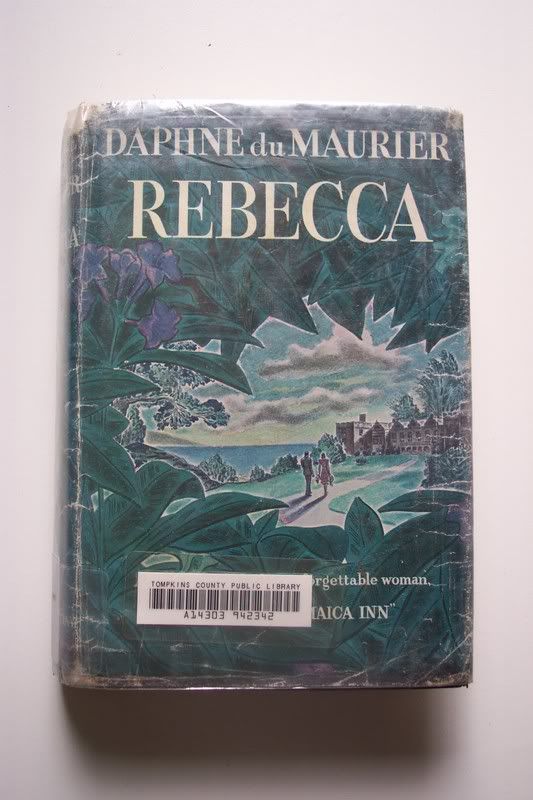
This post might not mean much to those of you whose mental DNA was not forged in the public library. But if yours was... look at this gorgeous thing!

Photobucket - Video and Image Hosting

I wanted to reread Rebecca this summer and found this copy at the Tompkins County Public Library. It looks like it's over fifty years old, and has been read maybe 300 times. (In fact, according to Wikipedia: "Though literary critics have often berated Du Maurier's writings for not being 'intellectually heavyweight' ... for several decades she was the number one author for library book borrowings.")

Photobucket - Video and Image Hosting

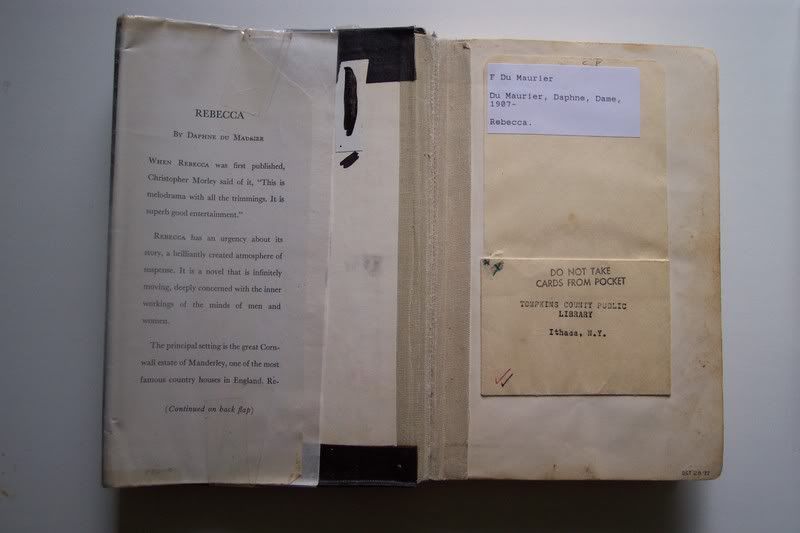
Look at how carefully this book was maintained over the years -- the cloth tape at the binding, the later plastic tape at the edges.

Photobucket - Video and Image Hosting

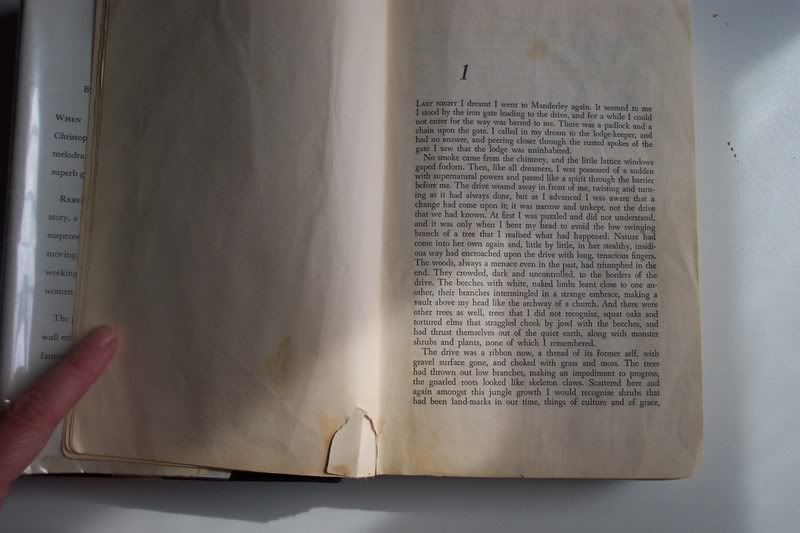
Great first line: "Last night I dreamt I went to Manderley again." The bottom of the page is practically worn out from all those thumbs holding it.

Photobucket - Video and Image Hosting

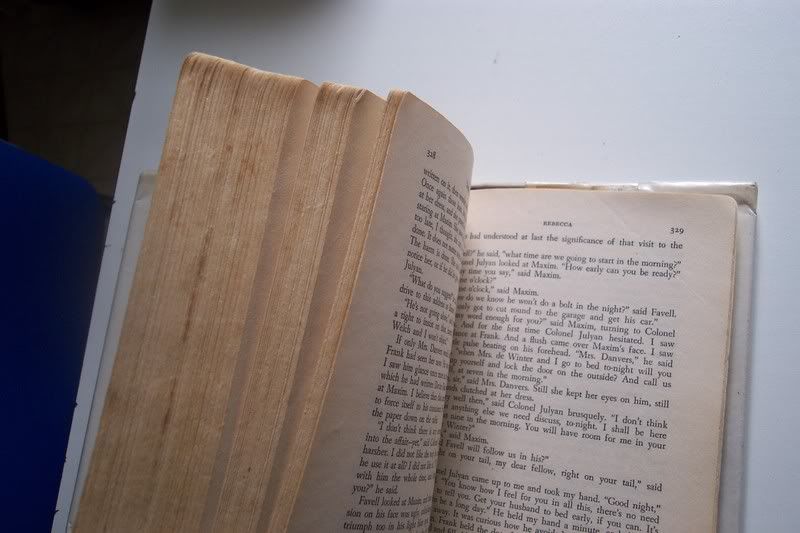
There's a wonderful soft/rough quality to the pages of old, well-read books. They smell good too.

I was tempted to steal this from the library -- I know they have a tendency to ditch old books, and was amazed this one survived as long as it did. But that would be wrong. It's a library book, and it needs to live out its life as one... but I thought I'd take some pictures of it.

An Interview...With Us

Susan Tomaselli of Dogmatika, guest blogging at 3am Magazine, has interviewed Rhian and me about our work and about this blog. The interview's in two parts, here and here. Thanks a lot, Susan!

In other news, I'm gonna stop underlining hyperlinks. Blogger doesn't offer an underline button, for some reason, and all this html is hurting my hand.

Thursday, February 1, 2007

New David Wallace Story

Speaking of short stories...David Foster Wallace has a new one, called "Good People," in the latest New Yorker, and it's really excellent. It's short, and very simple--a 19-year-old devout Christian kid is standing in a park, contemplating whether or not he loves the girl he has impregnated. The word "abortion" does not appear, but that's what he's really thinking about.

I've always liked Wallace a lot. It's kind of a shame that his fame accreted around Infinite Jest...not that it's a bad book. Indeed, it's great in many ways, but it's also this big bloated sloppy thing that kind of obscures the incredible clarity that Wallace is so adept at achieving. His eye and ear (especially his ear) are peerless. And maybe more importantly, he is willing--far more than his other metafiction-slingin' contemporaries--to risk sentimentality. He teeters often on the edge of vulnerability and sweetness, and that edge is where he does some of his best work.

This story is right there on that edge. His protagonist gives himself over to love--or, rather, to the possibility that he doesn't know what the hell love is. It'd be sappy if it weren't so clear and true and honest. The prose, as ever, is simultaneously incisive and rambling, as in this bit of scene-setting:

Lane was very still and immobile and looking past the bank at the downed tree in the shallows and its ball of exposed roots going in all directions and the tree's cloud of branches all half in the water. The only other individual nearby was a dozen spaced tables away, by himself, standing upright. Looking at the torn-up hole in the ground there where the tree had gone over. It was still early yet and all the shadows wheeling right and shortening.

Nice. Go give it a look.